# Classes - JS
Used to quickly produce similar objects:
create a template of an object -› reduce duplicate code and debugging time.
class Dog {
  constructor(name) {
    this._name = name;
    this._age = 3;
  }

  get name() {
    return this._name;
  }
  get age() {
    return this._age;
  }

  incrementAge() {
    this._age++;
  }
}
# Constructor
JavaScript calls the constructor() method every time it creates a new instance of a class.
class Dog {
  constructor(name) {
    this.name = name;
    this.age = 3;
  }
}
Dogis the name of the class.- Convention, capitalize and CamelCase class names.
- Inside of the
constructor()method, thethiskeyword refers to an instance of that class.
# Instance
An instance is an object that contains the property names and methods of a class, but with unique property values.
new - Javascript calls a constructor method to create a new instance
class Dog {
  constructor(name) {
    this.name = name;
    this.age = 0;
  }
}

const charlie = new Dog('Charlie'); // Create new Dog instance
console.log(charlie.name); // Log the name value saved to charlie
// Output: 'Charlie'
# Methods
- Class method and getter syntax is the same as it is for objects except you don't include commas between methods.
class Dog {
  constructor(name) {
    this._name = name;
    this._age = 3;
  }

  get name() {
    return this._name;
  }

  get age() {
    return this._age;
  }

  incrementAge() {
    this._age++;
  }
}
- use getter methods for
nameandage - prepended the property names with underscores (
_nameand_age) -› indicates that these properties should not be accessed directly
# Inheritance
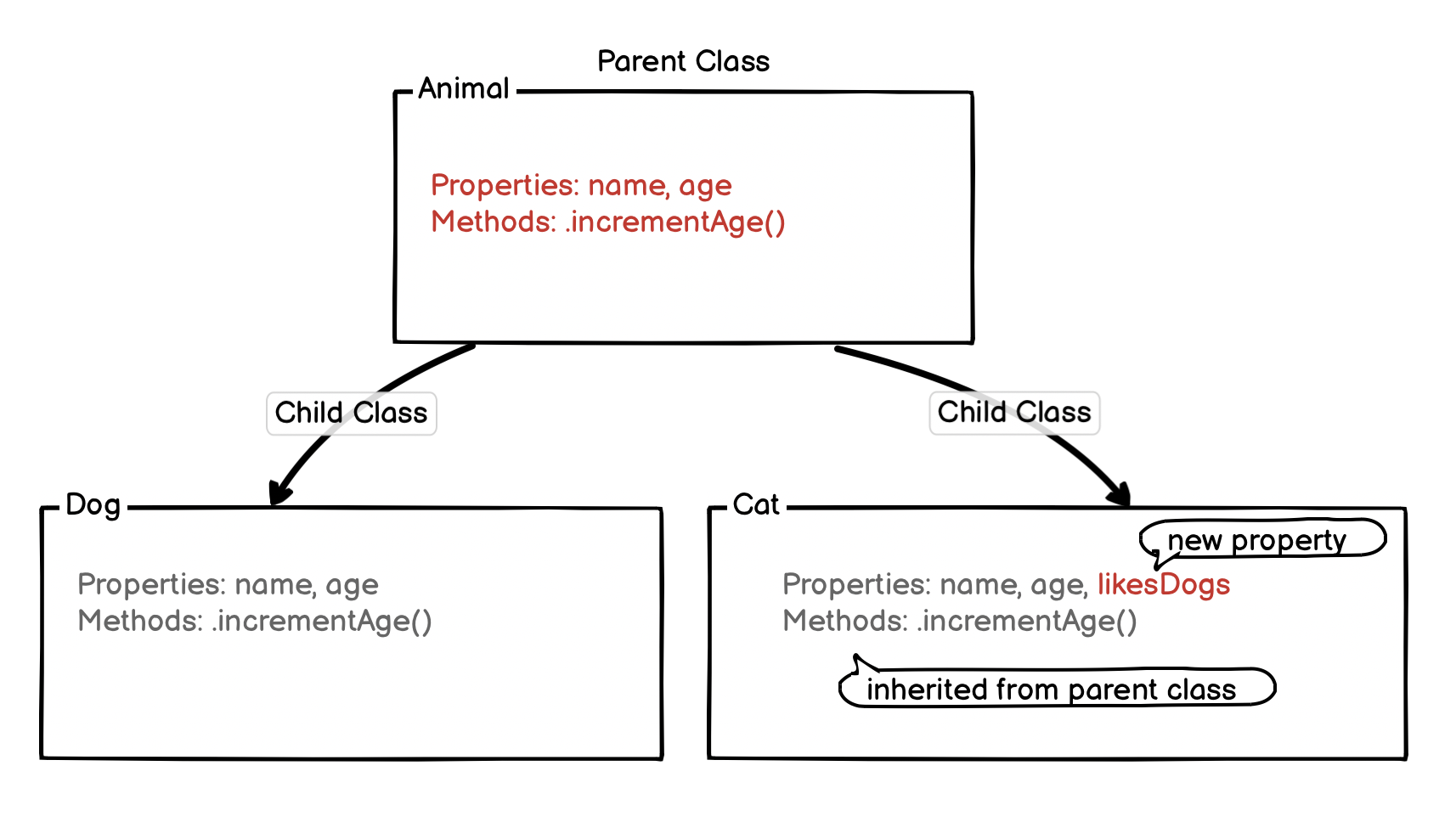
Create a parent class with properties and methods that we can extend to child classes.
When multiple classes share properties or methods, they become candidates for inheritance
# Parent Class
Create a parent class (also known as a superclass) with properties and methods that multiple child classes (subclasses) share.
class Animal {
  constructor(name) {
    this._name = name;
    this._age = 3;
  }

  get name() {
    return this._name;
  }

  get age() {
    return this._age;
  }

  incrementAge() {
    this._age++;
  }
}
Animal class contains the properties and methods that the Cat and Dog classes share (name, age, .incrementAge()).
# Subclass
extendscreates a subclasssupercalls theconstructor()of a parent class
class Cat extends Animal {
  constructor(name, likesDogs) {
    super(name);
    this._likesDogs = likesDogs;
  }
}
Create a new Cat instance:
const luluCat = new Cat('Lulu', false);
extendsmakes the methods of the animal class available inside the cat class- The constructor, called when you create a new
Catobject, accepts two arguments,nameandlikesDogs. supercalls the constructor of the parent class_likesDogsis a new property that is unique to theCatclass -› set it in theCatconstructor
In a constructor(), always call super() before you can use this - otherwise, JavaScript will throw a reference error.
Best practice: call super on the first line of subclass constructors!
# Subclass Methods:
All of the parent methods are available to the child class.
Because luluCat has access to the name getter, the code below logs 'Lulu' to the console.
console.log(luluCat.name);
Additionally, child classes can contain their own properties, getters, setters, and methods.
class Cat extends Animal {
  constructor(name, likesDogs) {
    super(name);
    this._likesDogs = likesDogs;
  }

  get likesDogs() {
    return this._likesDogs;
  }
}
# Static Methods
Static methods are called on the class, but not on instances of the class
Example: the
Dateclass:
- can both create
Dateinstances to represent whatever date, and call static methods, likeDate.now()which returns the current date.- The
.now()method is static -› can be called directly from the class, but not from an instance of the class
static creates a static method called generateName (returns a random name when it’s called)
class Animal {
  constructor(name) {
    this._name = name;
    this._age = 3;
  }

  static generateName() {
    const names = ['Abby', 'Candy', 'Buffy', 'Emmy', 'Honey'];
    const randomNumber = Math.floor(Math.random() * 5);
    return names[randomNumber];
  }
}
Call with the following syntax:
console.log(Animal.generateName()); // returns a name
You cannot access the
.generateName()method from instances of theAnimalclass or instances of its subclasses
# Simple constructor function
capitalized!
function HouseKeeper(name, age, hasWorkPermit) {
  this.name = name;
  this.age = age;
  this.hasWorkPermit = hasWorkPermit;
}
const houseKeeper1 = new HouseKeeper('Carla', 33, true);
# methods
function HouseKeeper(name, age, hasWorkPermit) {
  this.name = name;
  this.age = age;
  this.hasWorkPermit = hasWorkPermit;
  this.clean = function() {
    alert('cleaning in progress');
  };
}
# Links
← Play audio Dates →